
Summary
- What happened: On the night of March 22, 2026, Air Canada Express Flight 8646 (a CRJ-900 arriving from Montreal with 72 passengers and four crew members) struck a Port Authority fire truck on Runway 4 at LaGuardia Airport in East Elmhurst, Queens. Both pilots were killed and 41 people were transported to area hospitals. The NTSB is leading the investigation, with the FAA co-investigating. (CNN, USA Today)
- Why it may matter legally: If the investigation confirms that an air traffic control error, inadequate ATC staffing, or other operational failures contributed to this collision, injured passengers and the families of the deceased pilots may have legal claims under both New York and federal law against multiple parties, including the Port Authority of New York and New Jersey and the air carrier.
- Time-sensitive: Claims against the Port Authority are governed by New York Unconsolidated Laws § 7107: a notice of claim must be served at least 60 days before suit, and the lawsuit must be commenced within one year of the accident (on or about March 22, 2027 for this crash). Claims against private defendants may allow more time (generally three years for personal injury and two years for wrongful death). Preserving evidence and meeting these deadlines is critical to protecting your rights.
- Next steps: If you were injured, we can help. Raphaelson & Levine has recovered over $1 billion for injury victims, including a $2.5 million wrongful death claim in an aviation accident case and many accident claims directly against the Port Authority. For a free consultation with the firm's aviation accident attorneys, call (212) 268-3222.
How Did a Fire Truck End Up on an Active Runway at LaGuardia?
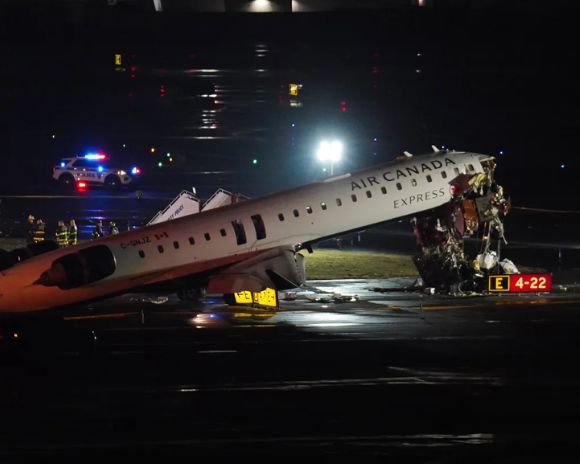
On Sunday, March 22, 2026, according to Reuters and a statement from Jazz Aviation at approximately 11:38 to 11:47 p.m. ET, Air Canada Express Flight 8646, a Bombardier CRJ-900 regional jet operated by Jazz Aviation on behalf of Air Canada, collided with a Port Authority Aircraft Rescue and Firefighting (ARFF) vehicle on Runway 4 at LaGuardia Airport in East Elmhurst, Queens. The aircraft was arriving from Montreal with 72 passengers and four crew members aboard. (Reuters)
Both pilots, the captain and first officer, were killed. Port Authority Executive Director Kathryn Garcia confirmed at an early morning press conference that both were based in Canada. Forty-one people were transported to area hospitals; 32 had been released as of the pre-dawn briefing, while nine remained hospitalized, some with serious injuries. Two Port Authority officers aboard the fire truck, a sergeant and an officer, suffered broken bones but were reported in stable condition. (AP via ABC6, NPR, NY Post)
Photos and video from the scene showed the entire nose and cockpit section of the CRJ-900 destroyed, with the aircraft resting tilted upward on its tail. The fire truck was found overturned on its side, also heavily damaged. One unaccompanied minor on the plane was later reunited with family, and all 72 passengers were accounted for. (USA Today)
The FAA issued a full ground stop at LaGuardia immediately after the collision, and the airport was closed through at least 2:00 p.m. on Monday, March 23. Incoming flights were diverted to JFK International and Newark Liberty International. NYC Emergency Management issued a public advisory warning of flight cancellations, road closures, and traffic congestion near the airport. Approximately 543 flights were canceled on March 23, stranding thousands of passengers. (NYT, USA Today)
What Are Investigators Examining?
The NTSB deployed a Go Team to LaGuardia, arriving at approximately 3:30 a.m. ET on March 23. NTSB Chair Jennifer Homendy and Member John DeLeeuw are serving as on-scene spokespeople. The FAA is co-investigating.
ATC runway crossing clearance
According to multiple news reports and publicly released air traffic control audio, the controller cleared the Port Authority fire truck to cross Runway 4 at taxiway Delta while Flight 8646 was simultaneously landing on (or rolling out on) the same runway. Seconds before impact, the controller was heard directing the truck:
"Truck One, stop, stop, stop!" In post-collision audio captured by LiveATC.net and reported by Newsweek and Canadian Travel News, one controller said: "I messed up," while another responded: "Nah man, you did the best you could." (CNN, Newsweek, Canadian Travel News)
That does not mean ATC error has been confirmed as the cause of this collision. It means that if investigators determine the runway crossing clearance was issued while the aircraft was still on the runway, that finding could become central to both the NTSB investigation and any subsequent civil liability analysis.
ATC staffing at the time of the collision
Multiple reports indicate the controller may have been working alone, handling both ground control and tower operations simultaneously at the time of the incident. No official statement from the FAA or NTSB has confirmed this as of available reporting. (CNN)
If confirmed, the question of whether adequate ATC staffing was in place could become a factor in both the federal investigation and any claims related to the collision. It is worth noting that The New York Times reported LaGuardia had already issued a travel advisory on Sunday about extended TSA security wait times due to a partial government shutdown causing personnel shortages, raising broader questions about airport operational conditions. (NYT)
The simultaneous emergency on a separate runway
The Port Authority fire truck was not on a routine crossing. It was responding to a separate emergency involving United Airlines Flight 2384, which had aborted takeoff due to an anti-ice warning light and reported an odor in the cabin. Flight attendants reportedly felt ill, and the aircraft declared an emergency when no gates were immediately available. (CBS News, News18)
Investigators are expected to examine whether the simultaneous management of two emergencies contributed to the breakdown in separation between the fire truck and the landing aircraft.
Runway safety systems
LaGuardia Airport is one of only 35 U.S. airports equipped with the FAA's ASDE-X (Airport Surface Detection Equipment, Model X) advanced surface radar system, which is designed to detect potential runway conflicts and alert controllers. Whether the system was functioning, whether it generated an alarm, and whether any alarm was acted upon have not been addressed in available reporting. (Brooklyn Eagle)
Prior runway incursion history at LaGuardia
This is not the first runway incursion event at LaGuardia. In May 2025, a Republic Airways jet operating for American Airlines aborted takeoff to avoid a United Airlines plane that was still on the runway; the FAA and NTSB launched investigations into that near-miss. In July 2007, the NTSB documented a separate runway incursion involving Delta and Comair flights on Runway 22. NTSB Report OPS07IA007)
Investigators may consider whether these prior incidents reflect patterns in ATC procedures or runway safety protocols at LaGuardia.
Can Passengers and Families Have Legal Claims After an Aviation Collision?
The investigation into this collision is ongoing. The following section provides general legal information about how liability is evaluated in aviation accident cases; it is not a conclusion about this specific incident or any specific party's liability.
How Is Liability Evaluated in an Aviation Accident Case?
Aviation accidents involve a complex intersection of federal and state law. The NTSB investigates the probable cause of aviation incidents and issues safety recommendations, while the FAA regulates air carrier operations, air traffic control procedures, and airport safety standards. Civil liability claims arising from aviation accidents may be brought under federal regulations, state negligence law, or both.
In a runway incursion case like this one, investigators and attorneys typically examine whether any party breached a duty of care. That duty can arise from federal regulations (such as FAA Order JO 7110.65 governing air traffic control procedures and runway crossing clearances), from the carrier's obligations to its passengers, or from the airport operator's obligation to maintain safe ground operations.
Potential responsible parties in this type of incident may include:
- The Port Authority of New York and New Jersey, which owns and operates LaGuardia Airport and staffs the Aircraft Rescue and Firefighting unit whose vehicle was involved in the collision
- The Federal Aviation Administration, which employs and supervises air traffic controllers at LaGuardia, if an ATC error or staffing shortfall contributed to the collision
- Jazz Aviation LP and/or Air Canada, the air carrier and its parent brand, if any aspect of the carrier's operations contributed to the incident
- Multiple parties simultaneously, as aviation accident claims frequently involve shared liability among government entities, carriers, and equipment operators
Claims against the Port Authority, a bi-state government entity, are governed by New York Unconsolidated Laws § 7107, which requires that a notice of claim be served at least 60 days before suit and that the lawsuit be commenced within one year of when the claim accrues. Claims against the federal government (including the FAA) are governed by the Federal Tort Claims Act (FTCA), which has its own procedural requirements and deadlines outlined in the section below.
What Compensation May Be Available After the LaGuardia Collision?
Injury claims may seek compensation for:
- Emergency and ongoing medical care (including treatment for fractures, head injuries, spinal injuries, soft tissue injuries, and psychological trauma)
- Lost wages and diminished earning capacity
- Physical rehabilitation and long-term care
- Pain and suffering, including emotional and psychological trauma
- Property loss
Wrongful death claims under N.Y. Estates, Powers and Trusts Law § 5-4.1 allow the personal representative of the deceased's estate to bring an action on behalf of the estate's distributees. Recoverable damages in a wrongful death action generally include funeral and burial expenses, medical expenses related to the final injury, and pecuniary losses to the distributees, including the financial value of the deceased's future earnings and, where applicable, loss of parental guidance and support.
Survival claims may also be available separately, allowing the estate to pursue damages for the decedent's conscious pain and suffering before death. Survival claims are legally distinct from wrongful death claims and are often filed alongside them. In an aviation collision of this nature, survival claims may be particularly significant if evidence establishes that the pilots experienced conscious pain and suffering in the moments before death.
What Evidence May Matter in a LaGuardia Runway Collision Case?
Aviation accident cases depend on evidence that can be difficult to obtain without prompt legal action. The types of records that may become relevant include:
- NTSB investigation reports, preliminary findings, and final probable cause determination
- FAA air traffic control audio recordings and transcripts
- Cockpit Voice Recorder (CVR) and Flight Data Recorder (FDR) data from the aircraft
- ASDE-X runway surface detection system logs and alert records
- ATC staffing schedules, shift logs, and fatigue management records
- Port Authority ARFF dispatch records and vehicle telemetry
- Airport surveillance camera footage from Runway 4 and taxiway Delta
- Flightradar24 and ADS-B tracking data showing aircraft speed and position
- Medical records from area hospitals where passengers were treated
- Maintenance and inspection records for both the aircraft and the ARFF vehicle
- Prior runway incursion reports and safety recommendations for LaGuardia Airport
Preserving this evidence promptly is critical. NTSB investigation materials are subject to federal record retention rules, but other evidence (such as surveillance footage, dispatch recordings, and ATC staffing records) may be subject to routine deletion. An attorney experienced in aviation accident cases can issue preservation demands to relevant agencies early in the process.
What Deadlines Apply to LaGuardia Collision Injury and Wrongful Death Claims?
Time limits in aviation accident cases can be shorter and more complex than in typical personal injury matters, particularly when government entities are involved.
Claims against the Port Authority of New York and New Jersey are governed by New York Unconsolidated Laws § 7107, not by the 90-day notice rule that applies to New York City and other municipalities. Under § 7107, a claimant must (1) serve a written notice of claim on the Port Authority at least 60 days before starting a lawsuit, and (2) commence the lawsuit within one year of the date the claim accrues. For an accident on March 22, 2026, the one-year deadline to sue the Port Authority falls on or about March 22, 2027 — and because the notice of claim must be served at least 60 days earlier, that notice should be served well before that date.
Failing to commence suit within this one-year period can bar recovery against the Port Authority. Because the Port Authority is a bi-state entity created by interstate compact, its deadlines are set by § 7107 and differ from typical New York municipal claims.
Claims against the federal government (including potential claims related to FAA air traffic control operations) are governed by the Federal Tort Claims Act (FTCA). The FTCA requires that an administrative claim be filed with the responsible federal agency within two years of the incident. Only after the agency denies the claim (or fails to act within six months) can a lawsuit be filed in federal court.
Personal injury claims under New York law are generally subject to a three-year statute of limitations from the date of injury under CPLR § 214. For claims against private defendants such as the air carrier, this three-year period would run to on or about March 22, 2029. It does not extend the deadline for claims against the Port Authority, which are governed by the shorter one-year period under § 7107.
Wrongful death claims under New York law are generally subject to a two-year statute of limitations from the date of death under N.Y. EPT § 5-4.1. This two-year period runs from the date of death and would fall on or about March 22, 2028 for claims against private defendants. Any wrongful death claim against the Port Authority must still be commenced within the one-year period required by § 7107.
The most urgent deadline in this case is likely the one-year period to commence suit against the Port Authority under § 7107 (on or about March 22, 2027 for this crash) with the required notice of claim due at least 60 days before that.
In cases involving aviation accidents, early legal intervention is critical to preserving evidence, securing expert analysis, and protecting the rights of victims and their families.
A personal injury attorney at our firm can help determine which deadlines apply to your specific situation, and ensure your full legal rights are protected.
What Steps Should You Take If You Were Injured or Lost a Loved One on Flight 8646?
- If you were injured, seek medical attention immediately, even if your injuries seem minor. Some injuries, including concussions, internal bleeding, and soft tissue damage, may not be immediately apparent. Medical documentation from the earliest possible date strengthens any future claim.
- If you lost a loved one, contact an attorney before taking any other legal steps. A wrongful death claim must be brought by the personal representative of the estate, which requires appointment through Surrogate Court. An experienced attorney can guide you through that process and ensure the § 7107 deadlines for Port Authority claims (a notice of claim served at least 60 days before suit, and suit commenced within one year) are not missed while the appointment is pending.
- Document what you can. Date-stamped photos of injuries, the airport, boarding passes, luggage tags, and personal belongings can become important evidence in a civil case. Save screenshots of flight records and any communications with the airline.
- Preserve all records. Keep copies of medical records, hospital bills, prescription receipts, travel itineraries, and any correspondence with Air Canada, Jazz Aviation, or the Port Authority. Do not discard boarding passes, baggage claim tickets, or travel insurance documents.
- Do not sign anything from an airline, insurance company, or government entity without first consulting an attorney. Early settlement offers or release forms may not reflect the full value of your claim.
- Register for airline assistance. Air Canada activated a family assistance line at 1-800-961-7099 for those affected. Airlines have offered fee-free rebooking for passengers on canceled flights. JFK and Newark are operating normally as alternatives.
- Understand the government deadlines. Claims against the Port Authority are governed by § 7107 — a notice of claim served at least 60 days before suit, and suit commenced within one year of the accident. Consulting an attorney early can help ensure no procedural deadline is missed.
- Contact an experienced aviation accident attorney. Aviation collision claims involve federal regulations, multiple government agencies, and complex procedural requirements that differ from standard personal injury cases. Call Raphaelson & Levine at (212) 268-3222 for a free consultation.
What Families and Passengers of Flight 8646 Should Know
Can I sue after a runway collision at LaGuardia Airport?
Injured passengers and the families of those killed in a runway collision may have legal claims against multiple parties, including the airport operator (the Port Authority of New York and New Jersey), the air traffic control authority (the FAA), and the air carrier (Jazz Aviation/Air Canada).
The specific claims available depend on what the investigation reveals about the cause of the collision. Because government entities are potentially involved, strict procedural requirements and shortened filing deadlines may apply.
How long do I have to file a claim after the LaGuardia Airport collision?
The deadlines depend on who the claim is against. Claims against the Port Authority are governed by New York Unconsolidated Laws § 7107 — a notice of claim must be served at least 60 days before suit, and the lawsuit must be commenced within one year of the accident (on or about March 22, 2027 here). Claims against the federal government under the Federal Tort Claims Act must be filed administratively within two years. Claims against private defendants generally allow three years for personal injury under CPLR § 214, and wrongful death claims allow two years under N.Y. EPT § 5-4.1. Consulting an attorney promptly can help ensure no deadline is missed.
What if an air traffic control error caused the LaGuardia collision?
If the NTSB investigation determines that an ATC error, such as clearing a fire truck to cross an active runway while an aircraft was landing, contributed to the collision, that finding could support negligence claims against the federal government under the Federal Tort Claims Act. Whether ATC staffing levels were adequate at the time of the incident may also become a factor. The investigation is ongoing, and no official cause has been determined.
What if my loved one was one of the pilots killed in the collision?
Families of the deceased may have wrongful death claims under N.Y. EPT § 5-4.1, which allows the personal representative of the estate to bring an action on behalf of the distributees. Recoverable damages generally include pecuniary losses such as future earnings, funeral expenses, and medical expenses related to the final injury.
Separate survival claims may also be available for the decedent's conscious pain and suffering before death. Because the pilots were based in Canada, additional jurisdictional and international law considerations may apply, and an attorney experienced in aviation wrongful death cases can help families navigate those complexities.
Were the pilots employed by Air Canada or a separate company?
Flight 8646 was operated by Jazz Aviation LP, a regional carrier headquartered in Halifax, Nova Scotia, flying under the Air Canada Express brand. The pilots were Jazz Aviation employees, not Air Canada employees. This distinction matters legally because it affects which entities may be named as defendants.
Both Jazz Aviation and Air Canada could potentially face claims depending on the investigation's findings, but the employment relationship and corporate structure between the two companies will be relevant to any litigation.
How New York City Aviation Accident Lawyers at Raphaelson & Levine Can Help
Raphaelson & Levine's aviation accident attorneys have represented families in aircraft collision wrongful death cases and have direct experience pursuing claims involving the Port Authority of New York and New Jersey and NYC-area airports.
The firm recovered a $2.5 million settlement in an aviation accident wrongful death case in which a passenger was killed in a commercial aircraft crash, with founding partner Howard Raphaelson serving as lead negotiator for a panel of attorneys. Howard Raphaelson has personally handled Port Authority cases, giving the firm firsthand knowledge of the procedural requirements, institutional dynamics, and litigation strategies specific to claims against bi-state government entities operating New York's airports. (Note: Prior results do not guarantee a similar outcome)
The firm is also currently representing two individuals who suffered amputations as a result of separate incidents at JFK International Airport.
"When a collision like this happens at a Port Authority airport, you're dealing with a bi-state government entity, federal aviation regulators, and an international carrier, each with different procedural rules and deadlines. Families need attorneys who have been through this process before and know exactly which claims to file, against whom, and how quickly they need to move." — Howard Raphaelson, founding partner
Founded in 1992, Raphaelson & Levine has recovered over $1 billion in total compensation for injured clients and their families. The firm was named Best Lawyers in America® for Personal Injury Litigation in New York City (2026) and maintains a 99% client satisfaction rate with over 600 five-star reviews from local clients.
Consultations are available in English, Spanish, and Mandarin.
We work on a contingency basis. You pay no attorney fees unless and until we recover compensation for you.
Call (212) 268-3222 or contact us online for a free case evaluation.


