
Tripped On A NYC Sidewalk? Here's Who's Responsible
In NYC, the owner of the property next to a sidewalk has to keep it safe. Here's when the City can be responsible instead, and why a claim against it needs a Notice of Claim within 90 days.

Andrew Levine
Partner
It takes half a second. A raised sidewalk flag catches your toe, or wet leaves hide a hole, and you're on the ground.
Who pays depends on exactly where you fell, and your deadline can be as short as 90 days or as long as three years.
The short answer
In New York City, the owner of the property next to a sidewalk is responsible for keeping it reasonably safe (NYC Administrative Code § 7-210).
The City can be responsible instead in front of owner-occupied one- to three-family homes used only as homes, and in front of City property. A claim against the City, NYCHA or the MTA needs a Notice of Claim within 90 days.
Where you fell | Who may be responsible | Deadlines |
|---|---|---|
In front of a store, office or apartment building | The property owner | Lawsuit within 3 years |
In front of a 1–3 family home the owner doesn't live in, or one with any business use | The property owner | Lawsuit within 3 years |
In front of an owner-occupied 1–3 family home used only as a home | Possibly the City, generally only with prior written notice of the defect | Notice of Claim within 90 days; lawsuit within 1 year and 90 days |
In front of a City school, park or building | The City | Notice of Claim within 90 days; lawsuit within 1 year and 90 days |
A broken curb, or the dirt area around a street tree | The City, generally only with prior written notice | Notice of Claim within 90 days; lawsuit within 1 year and 90 days |
Within 12 inches of a manhole cover, grate or vault cover | Whoever owns the cover: a utility company, the MTA or the building | Private company: lawsuit within 3 years. MTA: Notice of Claim within 90 days; lawsuit within 1 year and 90 days |
On NYCHA or MTA/NYC Transit property | NYCHA, the MTA or NYC Transit | Notice of Claim within 90 days; lawsuit within 1 year and 90 days |
At JFK, LaGuardia or the Port Authority Bus Terminal | The Port Authority | Notice at least 60 days before suing; lawsuit within 1 year |
On Long Island | Depends on the town or village code; towns and villages generally need prior written notice | Town, village or county: Notice of Claim within 90 days; lawsuit within 1 year and 90 days. Private owner: lawsuit within 3 years |
In front of a store, office or apartment building
The property owner
Lawsuit within 3 years
In front of a 1–3 family home the owner doesn't live in, or one with any business use
The property owner
Lawsuit within 3 years
In front of an owner-occupied 1–3 family home used only as a home
Possibly the City, generally only with prior written notice of the defect
Notice of Claim within 90 days; lawsuit within 1 year and 90 days
In front of a City school, park or building
The City
Notice of Claim within 90 days; lawsuit within 1 year and 90 days
A broken curb, or the dirt area around a street tree
The City, generally only with prior written notice
Notice of Claim within 90 days; lawsuit within 1 year and 90 days
Within 12 inches of a manhole cover, grate or vault cover
Whoever owns the cover: a utility company, the MTA or the building
Private company: lawsuit within 3 years. MTA: Notice of Claim within 90 days; lawsuit within 1 year and 90 days
On NYCHA or MTA/NYC Transit property
NYCHA, the MTA or NYC Transit
Notice of Claim within 90 days; lawsuit within 1 year and 90 days
At JFK, LaGuardia or the Port Authority Bus Terminal
The Port Authority
Notice at least 60 days before suing; lawsuit within 1 year
On Long Island
Depends on the town or village code; towns and villages generally need prior written notice
Town, village or county: Notice of Claim within 90 days; lawsuit within 1 year and 90 days. Private owner: lawsuit within 3 years
Not sure who owns that sidewalk, or which deadline is yours? We'll look up the owner and the City's notice records and tell you which rule applies. Free consultation. No fee unless we win.
Key takeaways
- A claim against the City generally also needs proof that the City had written notice of that exact defect before you fell, with narrow exceptions, such as when City work created the hazard.
- Fell in front of a private building? You have three years to file a lawsuit against the owner.
- The 90-day rule doesn't cover the Port Authority, which runs JFK, LaGuardia and the Port Authority Bus Terminal. It has its own deadlines.
- On Long Island, the town or village code decides whether the neighboring owner can be responsible. In the Town of Oyster Bay, it can.
- There's no minimum size for a sidewalk defect. A small crack can still matter.
Who’s Responsible if You Trip on a Sidewalk in NYC?
The owner of the property next to the sidewalk. Under NYC Administrative Code § 7-210, that owner has to keep the sidewalk reasonably safe. They can be held responsible for injuries caused by not fixing broken sidewalk flags or not clearing snow, ice, dirt or other material.
That's been NYC sidewalk law since September 2003, when the City shifted sidewalk responsibility to property owners. Owners can't dodge it by leasing out the building or hiring a maintenance company, but the duty stays with them.
That doesn't make every trip and fall an automatic case, though.
You still have to show the owner was careless, for example that they caused the defect, or knew about it (or should have) and didn't fix it.
We've seen this play out. In one of our cases, a piece of sidewalk was missing in front of a property, and our client broke her hip when she stepped into the gap. The claim was against the property owner who left the hazard in place, and it resolved in mediation for $540,000. Every case turns on its own facts.
Why Does the Exact Building Matter?
Picture two identical two-family houses side by side. The owner of the first lives upstairs and rents out the downstairs apartment.
The owner of the second lives out of state and rents out both floors. Trip in front of the first house, and your claim may be against the City, with a 90-day notice deadline. Trip a few steps later, in front of the second house, and your claim is against that owner, with three years to sue.
Same block, same kind of crack, different defendant, different deadline.
Which Part of the Sidewalk Did You Fall On?
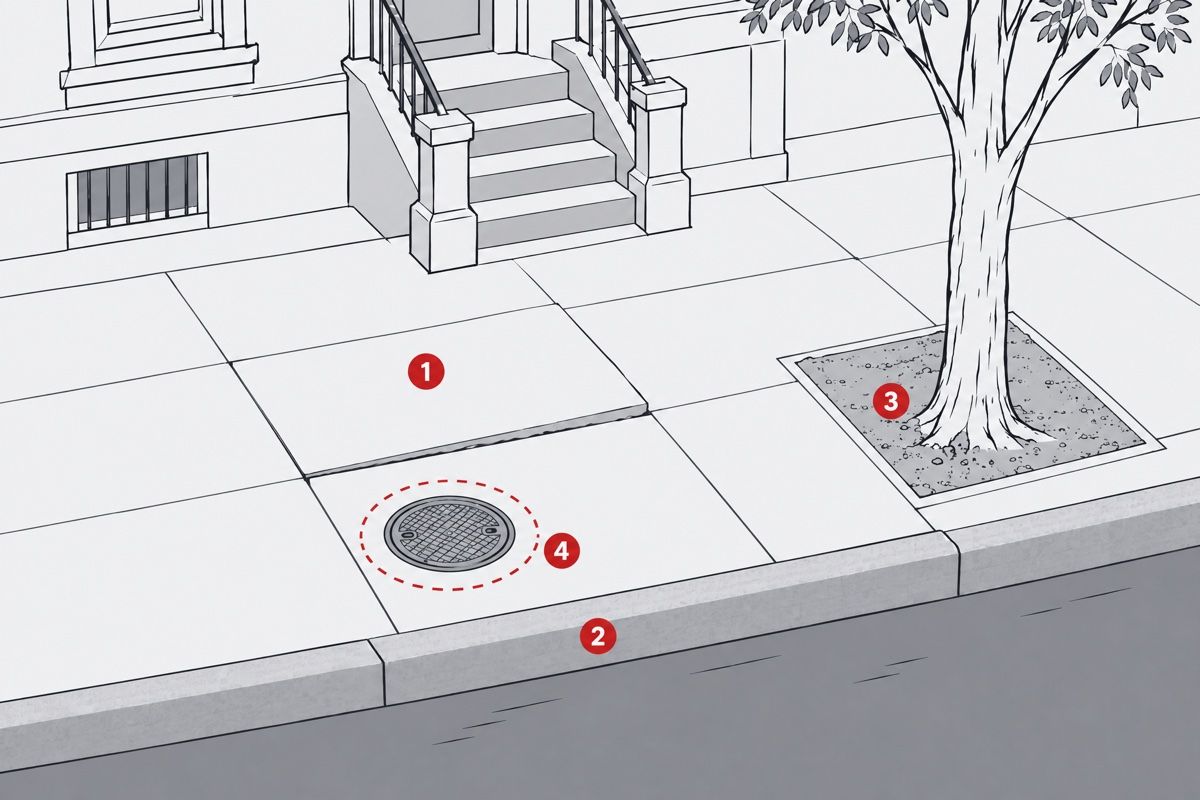
- Sidewalk flags: the owner of the property next to them, except in front of owner-occupied 1–3 family homes used only as homes.
- Curb: the City, generally only with prior written notice. The curb is part of the street.
- Tree well: not part of the owner's sidewalk duty. The City, generally only with prior written notice.
- Within 12 inches of a cover or grate: whoever owns the cover, under City DOT rule 34 RCNY § 2-07(b).
Is Repairing a Sidewalk the Same as Paying for an Injury?
No. Who's responsible for sidewalk repair in NYC is a separate question from who pays when someone gets hurt.
The owner-occupied exemption in § 7-210 covers injury claims, not repairs. Under Administrative Code § 19-152, property owners, homeowners included, are responsible for repairing the sidewalk flags in front of their property, and the City can order those repairs.
How Can You Tell Which Rule Applies?
NYC Department of Finance property records list a building's owner and its building class, which shows whether it's a one-, two- or three-family home. Whether the owner actually lives there takes more digging.
It's one of the first things we check, because it decides whether the claim runs against the owner or the City.
When Is the City Responsible for a Sidewalk Fall?
In two main situations: in front of owner-occupied one-, two- and three-family homes used only as homes, and in front of property the City owns, like schools, parks and City buildings.
“Owner occupied” means the owner actually lives there on a regular basis, not just that their name is on the deed.
Even then, the City is only on the hook if it got written notice of that exact defect before your accident and didn't fix it within 15 days. "The City should've known" isn't enough.
The written-notice rule has two narrow exceptions:
- When the City's own work created the hazard
- When the City used that stretch of sidewalk in a special way for its own benefit
What Is the Big Apple Map?
The Big Apple Pothole & Sidewalk Protection Committee, set up by the New York State Trial Lawyers Association, files maps with the City that mark sidewalk and street defects.
Those maps can count as the written notice the City needs. But only the map filed closest before your accident counts, and only for the defect actually drawn on it.
A mark for a different crack down the block won't help.
What Is a Notice of Claim, and When Is It Due?
A Notice of Claim is the formal written notice New York law requires before you can sue a city, county, town, village or other public agency for an injury. Under General Municipal Law § 50-e, it has to be served within 90 days after the claim arises.
It must be sworn, and it has to say when, where and how you got hurt. In New York City, you can file it online with the Comptroller's office.
When Is Your 90th Day?
Say you fell on November 10, 2026. Your 90th day to serve the Notice of Claim is February 8, 2027, and the deadline to sue the City is February 8, 2028.
Ninety days goes fast when you're juggling doctor visits, missed work and calls from insurance companies.
How Long Do You Have to File?
It depends on who's responsible. Against a private property owner, you have three years to sue. Against the City, NYCHA or the MTA, you need a Notice of Claim within 90 days and a lawsuit within 1 year and 90 days. The Port Authority needs notice at least 60 days before you sue, and the lawsuit within one year.
What Happens at a 50-h Hearing?
After you serve the notice, the City or agency can make you answer questions under oath at what's called a 50-h hearing, and it can ask for a medical exam. You can bring your lawyer. The hearing doesn't pause or extend your deadline to sue.
What If You Missed the 90-Day Deadline?
You may still have an option, but it's not guaranteed. A court can allow a late Notice of Claim. Judges look at whether the agency already knew the key facts, whether you had a good reason for the delay, and whether the delay hurt the agency's ability to defend itself. A court can't stretch the notice deadline past the time to sue, though.
What If a Loved One Died After the Fall?
The 90 days runs from when a court appoints the representative of the person's estate, and the lawsuit deadline is two years from the date of death.
What Should You Do After a Sidewalk Fall?
Move fast on evidence. The spot where you fell can be patched within days, and once it's gone, so is the best proof of what tripped you.
Sidewalk Fall Checklist
Tap each item as you check it off. Save a screenshot so it's on your phone if you ever need it.
Tell the doctor or ER that you fell on a sidewalk, so your records tie the injury to the fall.
Take wide shots that show the building and the street, then close-ups with a coin, key or ruler next to the defect. Size alone doesn't decide a sidewalk case, but the other side will still argue about it, and a photo with something for scale settles that fight.
Write down the street address, the nearest door or driveway, and which sidewalk flag. "Outside 120 Main Street, third flag from the corner" beats "on Main Street." Responsibility can change at the property line, and the City's written-notice rule only covers the exact defect.
People scatter fast. A neighbor or shop worker who saw you fall, or who knows how long that crack has been there, can make a real difference.
Don't wash, repair or toss them. If anyone asks whether your shoes played a part, you'll have the answer.
If the City, NYCHA, the MTA, or a Long Island town or village might be responsible, the Notice of Claim is due 90 days after the fall. Put that date on your calendar now.
Talk to a lawyer before you give one to the property owner's insurance company, the same as after any slip and fall.
How Many Sidewalk Injury Claims Are Filed Against NYC?
More every year. People filed 2,853 sidewalk injury claims against New York City in fiscal year 2026, the most in 21 years and up about a third since fiscal 2022.
From fiscal 2024 through 2026, the City paid about $190 million to resolve them.
Sidewalk Injury Claims Against NYC, Fiscal 2022 to 2026
- Fiscal 2022: 2,146 claims filed; $69.4 million paid to resolve claims.
- Fiscal 2023: 2,361 claims filed; $59.0 million paid.
- Fiscal 2024: 2,449 claims filed; $64.1 million paid.
- Fiscal 2025: 2,634 claims filed; $70.2 million paid.
- Fiscal 2026: 2,853 claims filed; $55.2 million paid.
Source: NYC Comptroller Claims Dashboard, claim type "Defective Sidewalk (PI)," read October 2026. Fiscal years run July to June. These numbers only count claims against the City, which since 2003 covers a narrow set of sidewalks, and they include snow and ice claims. Claims against private owners and their insurers aren't in public data. Payments in one year can resolve claims filed in earlier years.
Since the 2003 law moved responsibility to property owners, the number of sidewalk claims the City settles each year has dropped almost 90%, from 3,321 in fiscal 2001 to 403 in fiscal 2026.
Where Does the City Issue Sidewalk Violations?
In 2025, NYC Department of Transportation inspectors issued 8,945 sidewalk violations to property owners, and 43% of them were in Queens, more than any other borough. From 2020 to 2025, about 85% of violations were flagged as trip hazards.
Who's Responsible for Falls on Wet Leaves, Tree Roots or Snow?
Sidewalk complaints to 311 peak from August through October. Across 16 years of 311 data, October has the highest monthly median.
Wet leaves are the classic fall hazard. They hide cracks, raised flags and holes, and they're slippery on their own. But NYC's sidewalk law names "snow, ice, dirt or other material," not leaves.
So who's responsible for a fall on wet leaves depends on the facts, especially what was under them. A broken flag under the leaves is judged like any other sidewalk defect.
Tree roots are trickier. When a street tree's roots push up a sidewalk flag, it's natural to blame the City for the tree. But courts have held that failing to deal with tree roots isn't the kind of act that gets around the City's written-notice rule, and the owner's sidewalk duty can still apply. Talk to a lawyer before you decide who's responsible.
Winter brings its own rule.
NYC gives property owners four hours after snow stops falling to clear the sidewalk, not counting 9 p.m. to 7 a.m. And owners generally aren't responsible for snow or ice while a storm is still going on.
Who's Responsible for a Sidewalk Fall on Long Island?
Long Island plays by different rules. Whether a neighboring property owner is responsible depends on the local town or village law. And towns and villages can't be sued over a sidewalk defect unless they got written notice of that exact spot first (Town Law § 65-a, Village Law § 6-628).
- Town of Oyster Bay (including Woodbury): local law makes the owner and occupant of the property next to a sidewalk responsible for injuries caused by not maintaining or repairing it. This town law covers the town's unincorporated areas, like Woodbury; incorporated villages have their own codes.
- Town of Hempstead: the town needs prior written notice of the specific defect. A neighboring owner is generally liable only if they caused the defect, for example with a bad repair, or made special use of the sidewalk.
- Nassau County has its own written-notice rule for county sidewalks and roads.
If a town, village or county may be responsible, the same deadlines apply: a Notice of Claim within 90 days, and a lawsuit within 1 year and 90 days.
A town's failure to deal with tree roots doesn't, by itself, get around the written-notice rule.
Is a Small Crack Too Small to Matter?
No. There's no minimum size. You'll see "half an inch" or "one inch" online as a cutoff, but New York's highest court has rejected any minimum height or depth rule (Hutchinson v Sheridan Hill House Corp., 2015).
Courts look at the whole picture instead: how wide, deep and high the defect is, its shape, and the time, place and circumstances of the fall. A small defect can still count if it has a jagged edge, sits among other cracks, is poorly lit, or is somewhere busy, like a building entrance, where people look ahead instead of down at their feet.
Courts can still decide a defect is too minor to support a claim. That's why clear photos and measurements taken right away carry so much weight.
Can You Still Recover if You Were Partly at Fault?
Yes. For a sidewalk fall, New York lets you recover even if you were partly at fault, say you were glancing at your phone. Your share of the blame reduces what you get, but it doesn't wipe out your claim (CPLR 1411).
Common Questions About NYC Sidewalk Falls
The owner of the property next to the sidewalk is responsible for keeping it reasonably safe under NYC Administrative Code § 7-210.
The City can be responsible in front of owner-occupied one- to three-family homes used only as homes, and in front of City property.
Yes, in the places the City is responsible for, such as in front of City property or an owner-occupied one- to three-family home.
The City generally must have had prior written notice of the defect, with narrow exceptions such as when City work created the hazard. You also have to serve a Notice of Claim within 90 days.
If you own a building in NYC that isn't an owner-occupied one- to three-family home used only as a home, yes.
§ 7-210 makes you responsible for injuries caused by not keeping the sidewalk reasonably safe. The injured person still has to show you were careless.
Against a private property owner, it's three years.
Against the City, NYCHA, the MTA or NYC Transit, you need a Notice of Claim within 90 days and a lawsuit within 1 year and 90 days. The Port Authority's deadline to sue is one year.
It's the sworn, written notice New York law requires before you can sue a city, county, town, village or other public agency for an injury.
It says when, where and how you got hurt.
It's a session where the City or other public agency questions you under oath about your claim after you serve a Notice of Claim.
You can bring your lawyer, and it doesn't extend your deadline to sue.
It's a set of maps filed with the City that mark sidewalk and street defects.
A map can count as the written notice the City needs before it can be held responsible for a specific defect.
Under a City DOT rule, whoever owns the cover or grate is responsible for it and for the sidewalk within 12 inches of its edge.
That can be a utility company, the MTA or the building itself, not necessarily the property owner next to the sidewalk.
No. New York courts don't use a minimum height or depth.
They look at the defect's size, shape and location, the lighting, and what was happening when you fell.
It depends on the facts.
NYC's sidewalk law covers "snow, ice, dirt or other material" but doesn't name leaves, and leaves can hide a crack or hole that's its own problem.
Yes. Long Island towns and villages generally need prior written notice of a specific defect before they can be held responsible.
Whether a neighboring owner is responsible depends on local law. In the Town of Oyster Bay, local law makes the owner and occupant responsible for injuries from not maintaining or repairing the sidewalk.
Sources
- NYC Administrative Code § 7-210 (sidewalk duty of abutting owners) and § 7-201 (prior written notice)
- Rules of the City of New York, Title 34, § 2-07 (covers and gratings)
- NY General Municipal Law § 50-e, § 50-h and § 50-i; CPLR 214 and CPLR 1411; Town Law § 65-a; Village Law § 6-628; Unconsolidated Laws § 7107
- NYC Comptroller Claims Dashboard and Annual Claims Reports
- NYC Open Data: 311 Service Requests and DOT sidewalk violations
- Town of Oyster Bay Code § 205-2 and § 160-1; Town of Hempstead Code § 6-3
- Hutchinson v Sheridan Hill House Corp., 26 NY3d 66 (2015); Nieves v City of New York, 2023 NY Slip Op 02525; Vucetovic v Epsom Downs, 10 NY3d 517 (2008); Yarborough v City of New York, 10 NY3d 726 (2008); D'Onofrio v City of New York, 11 NY3d 581 (2008)
General information only, not legal advice. Reading it doesn't create an attorney-client relationship. Deadlines depend on the facts of each case, so speak with an attorney at Raphaelson & Levine about your own injury or claim.


Free Consultation.
No Fee Unless We Win.
Overwhelmed with medical expenses, lost wages, pain, & suffering? Don't settle with an insurance company for less than you deserve. We're here for you.
We’re available to you 24/7
You'll have direct access to a paralegal, a dedicated attorney, and a dedicated partner
34 years of experience representing injured New Yorkers
- Get Directions
Manhattan
14 Penn Plaza Suite 1718 New York, NY 10122(212) 268-3222 - Get Directions
Long Island
135 Crossways Park Dr Suite 404 Woodbury, NY 11797(212) 268-3222 - Get Directions
Flushing
136-68 Roosevelt Ave Suite 709 Flushing, NY 11354(917) 828-3820