
Flatbush Building Collapse at 1321 Flatbush Avenue: What Injured Families and Workers Should Know About Their Legal Rights
8 killed, including 2 children, and at least 18 hurt when 1321 Flatbush Ave. fell into a Brooklyn construction site. Who may be responsible, deadlines, next steps.

Howard Raphaelson
Partner
Key Takeaways
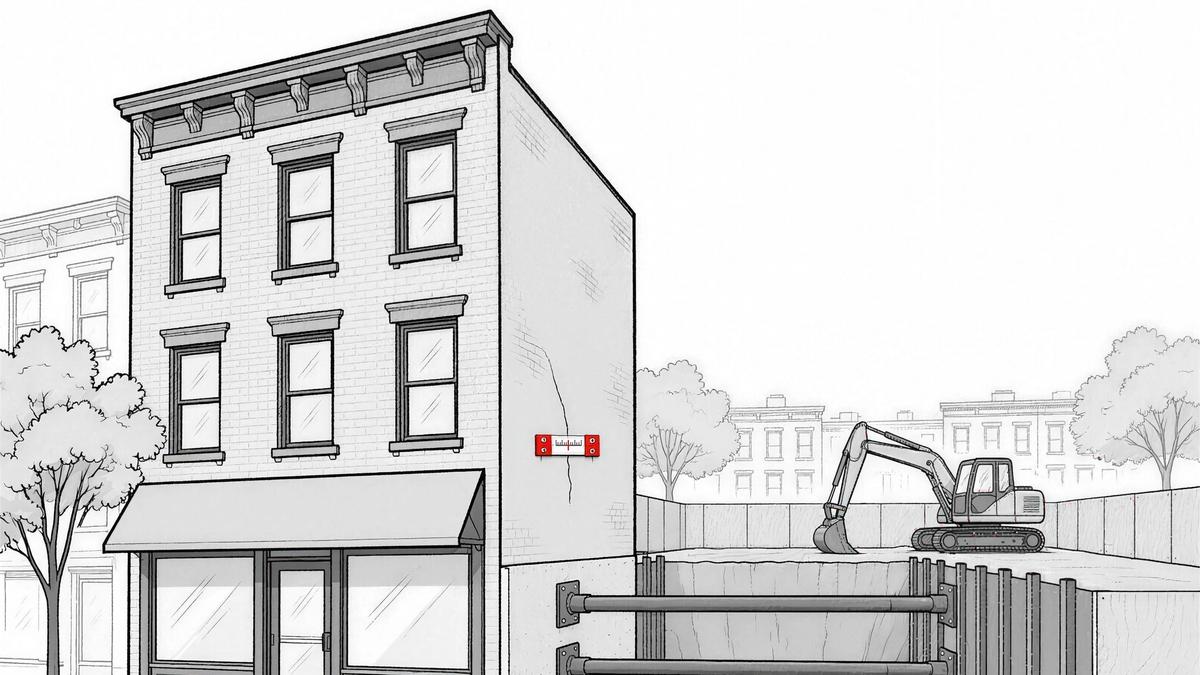
- Shortly after 4 p.m. on November 11, 2026, a three-story building at 1321 Flatbush Avenue in Brooklyn collapsed into an active excavation at 2625 Bedford Avenue. Mayor Zohran Mamdani said eight people died, including two children, and at least 18 were injured.
- The Department of Buildings issued a full stop-work order at the construction site, citing "unsafe construction operations causing adjacent building (1321 Flatbush Avenue) to collapse." The full cause is still under investigation.
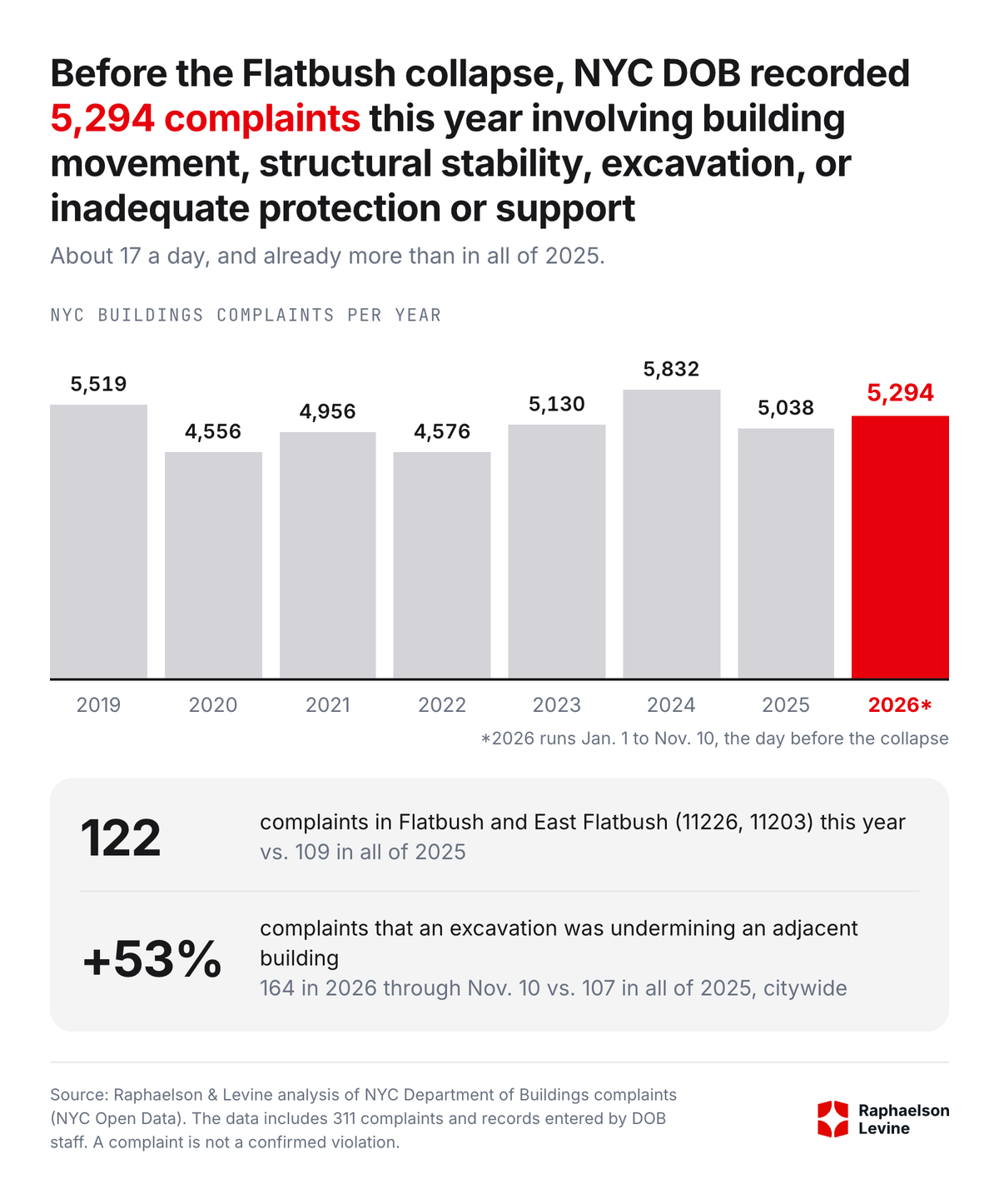
- Our analysis of city data found the NYC Department of Buildings recorded 5,294 complaints this year, before the collapse, involving building movement, structural stability, excavation, or inadequate protection or support. That is more than in all of 2025.
- Residents, neighbors, people passing by and construction workers may each have different legal claims. Deadlines are strict, and evidence at a collapse site can disappear quickly. Our New York building collapse lawyers offer a free consultation at (212) 268-3222.
What Happened in the Flatbush Building Collapse on November 11, 2026?
Shortly after 4 p.m. on November 11, a three-story building at 1321 Flatbush Avenue in Brooklyn collapsed into an active excavation at 2625 Bedford Avenue. At a November 12 briefing, Mayor Zohran Mamdani said eight people had died, including two children, and at least 18 people had been injured. The cause remains under investigation.
Workers were digging at the site when the building came down. The neighboring building at 1323 Flatbush Avenue lost part of an exterior wall, leaving apartments exposed, and the FDNY has warned that a secondary collapse is the main danger as recovery continues.
Many were taken to Kings County Hospital, and ABC7 New York reports that several of those killed appear to have been construction workers. Public schools were closed for Veterans Day.
What Caused the Flatbush Building Collapse?
The cause of the Flatbush collapse has not been officially determined, but the stop-work order the NYC Department of Buildings (DOB) issued at the construction site next door cites unsafe construction operations that caused the collapse, and DOB is still investigating.
- DOB tied its stop-work order to the construction next door. DOB Commissioner Ahmed Tigani said crews were "digging down" when the building fell. The stop-work order DOB issued Wednesday cites "unsafe construction operations causing adjacent building (1321 Flatbush Avenue) to collapse," as reported by Construction Dive.
- The construction lot had already been cited this year. DOB issued a stop-work order at 2625 Bedford Avenue in March, during demolition of a one-story building, because required safety measures such as netting and sidewalk sheds were missing. In April, an inspector found demolition had continued in violation of that order and issued another penalty, Gothamist reports.
- The excavation plans called for protecting the building next door. Engineering plans filed with DOB called for shoring to support neighboring buildings, vibration monitors, and crack gauges on surrounding buildings, under a special inspector's supervision. It is not yet known whether those steps were followed.
- The collapsed building was 96 years old. 1321 Flatbush Avenue was built in 1930, according to NY1. Records from the NYC Department of Housing Preservation and Development (HPD) list 98 open housing-code violations against the building.
- Plans for the lot grew. DOB approved a three-story building for the site. A newer plan for a nine-story building had not been approved, according to CBS New York.
Anyone can look up the permit, complaint and violation history of a New York City building on DOB NOW.
NYC Building Stability and Excavation Complaints Topped All of 2025 Before the Collapse
Before the collapse, the NYC Department of Buildings (DOB) had already recorded 5,294 complaints in 2026 involving building movement, structural stability, excavation, or inadequate protection or support, more than in all of 2025, according to our review of DOB complaint data on NYC Open Data.
Complaints | 2026 (Jan. 1 to Nov. 10) | All of 2025 |
|---|---|---|
Citywide | 5,294 | 5,038 |
Brooklyn | 1,975 | 1,801 |
Flatbush and East Flatbush (ZIPs 11226 and 11203) | 122 | 109 |
Excavation undermining an adjacent building (citywide) | 164 | 107 |
That’s about 17 complaints a day citywide. In Flatbush and East Flatbush, October was the busiest month of 2026 through November 10, with 18 complaints. Citywide, complaints that an excavation was undermining an adjacent building rose 53%, from 107 in all of 2025 to 164 in 2026 through November 10.
Who’s Responsible When a Building Collapses Into a Construction Site in New York?
In New York City, whoever causes an excavation generally must protect neighboring buildings at their own expense under NYC Building Code § 3309.4, so the construction site's owner, developer and contractors may be responsible when that protection fails. Whether the neighboring owner gave permission to access their property can affect how that duty applies.
The investigation into this collapse is ongoing. Nothing here is a conclusion about any party's responsibility.
Depending on what investigators find, parties who may be responsible could include:
- The owner and developer of the construction site at 2625 Bedford Avenue
- The general contractor and excavation, shoring or foundation subcontractors
- The owner or manager of 1321 Flatbush Avenue, if the building's own condition played a role
- More than one party at once, since New York law allows responsibility to be shared
Who was hurt | Type of claim | Usually brought against |
|---|---|---|
Residents, neighbors and people passing by | Negligence and premises liability | Construction site owner, developer and contractors, and the owner of the collapsed building |
Construction workers | Workers' compensation, plus Labor Law § 240 and § 241(6) claims in some cases | Employer (workers' compensation); property owner and general contractor (Labor Law) |
Families of those killed | Wrongful death and survival claims, brought by the estate's personal representative | The same parties as the injury claims |
Property owners must keep their buildings reasonably safe, which is the core of New York’s premises liability law. Workers' claims under the Scaffold Law (Labor Law § 240) and Labor Law § 241(6) depend on the work being done.
Families who have lost a loved one can bring wrongful death claims under N.Y. Estates, Powers and Trusts Law § 5-4.1, and a separate survival claim may cover a person's conscious pain and suffering before death.
What Evidence Matters After a Building Collapse?
After a building collapse in New York, the evidence that matters most is the construction site's permits, shoring and monitoring records, inspection history and video, and much of it can disappear once the site is cleared.
Records that may matter include:
- FDNY and NYPD incident reports
- DOB permits, inspection records, stop-work orders and violation history for both properties
- Excavation, shoring and underpinning plans, plus vibration and crack monitoring records for the neighboring building
- Site safety logs, special inspection reports, daily reports and photos from the construction site
- Surveillance and phone video from nearby buildings and stores
- Witness statements from residents, workers, neighbors and first responders
- Medical records from Kings County Hospital and other providers
Video is often overwritten within days. Our building collapse lawyers can send preservation letters to the owners, contractors and nearby businesses so this evidence is kept.
How Long Do You Have to File a Claim After a Building Collapse in New York?
In New York, injury claims from the Flatbush collapse generally must be filed within three years, wrongful death claims within two years of the death, and any claim against New York City needs a Notice of Claim within 90 days.
Claim | Deadline | Law |
|---|---|---|
Injury | 3 years from the injury | |
Wrongful death | 2 years from the date of death | |
Claim against New York City or a city agency | Notice of Claim within 90 days; lawsuit within 1 year and 90 days |
Our New York building collapse lawyers review each situation individually, and confirm which deadlines apply.
What Should You Do in the First Days After the Flatbush Collapse?
In the first days after the Flatbush collapse, get medical care, keep every record, and get legal advice before you give a statement or sign anything.
- Get medical care, even for injuries that seem minor. Crush injuries, head injuries and dust exposure can get worse over time.
- Get help with housing and supplies. New York City Emergency Management and the Red Cross opened a reception center at the Flatbush YMCA, 1401 Flatbush Avenue.
- Keep every record: hospital paperwork, your lease, messages with your landlord or employer, Red Cross paperwork and receipts.
- Save photos and videos you or neighbors took before or after the collapse, including any of the construction next door.
- Write down what you saw and heard, such as cracking, shaking or work at the site in the days and weeks before.
- Don't give recorded statements or sign anything from an insurance company, developer or contractor before you get legal advice.
- Talk to a lawyer early so evidence can be preserved. The consultation is free.
Quick Answers About the Flatbush Building Collapse
In New York, it depends on the cause. Building owners must keep their property reasonably safe, and when excavation next door is involved, the developer and contractors on that project must protect neighboring buildings. More than one party can share responsibility.
Yes, if negligence caused or contributed to the collapse. A tenant who was hurt, or who lost a family member, may have a claim against the parties responsible, and may also have rights related to relocation and the lease. Our lawyers can review the facts in a free consultation.
Sometimes. Workers' compensation is usually the claim against the employer, but New York Labor Law § 240 and § 241(6) can allow claims against the property owner and general contractor in some construction accidents, depending on the work being done.
Call 311 or file a complaint with the NYC Department of Buildings. If you see new cracks, falling debris or a building that is moving, leave the building and call 911.
Generally three years for injuries and two years from the date of death for wrongful death. Claims against New York City need a Notice of Claim within 90 days. Our New York building collapse lawyers will confirm which deadlines apply.
How Our New York Building Collapse Lawyers Can Help
Raphaelson & Levine Law Firm has represented injured New Yorkers since 1992 and has recovered over $1 billion for clients across the five boroughs, Long Island, and Greater New York.
Our building collapse lawyers and scaffold accident lawyers have handled collapses on job sites and in homes and storefronts, including:
- $8.5M Building Collapse Settlement in Bronx County for a young boy whose leg had to be amputated after a storefront wall on the Grand Concourse collapsed on him. The building's owner had been issued a violation for failing to maintain the exterior wall.
- $1.2 Million Scaffold Collapse Settlement in Queens for a worker hurt when an improperly assembled scaffold toppled. We showed the general contractor failed to inspect it.
- $525,000 Scaffold Fall Settlement in Brooklyn for a construction worker who fell from a scaffold on a Brooklyn job site.
Prior results do not guarantee a similar outcome.
Raphaelson & Levine has earned a Best Law Firms® Tier 1 ranking in New York City for Personal Injury Litigation – Plaintiffs (2025-2027), and our team brings 248+ combined years of experience to building collapse and construction cases.
We represent injured people and families only, never insurance companies, and work on a contingency basis which means no fee unless we win. Consultations are available 24/7 in English, Spanish and Mandarin.
To discuss your situation, call (212) 268-3222 or contact us online for a free consultation.
Sources (16)
- NYC Department of Buildings complaints (NYC Open Data): source of the complaint counts in this article, the table and the chart. Methodology: Raphaelson & Levine counted complaints in four DOB complaint categories (codes 03, 14, 16 and 30): building shaking or structural stability affected; adjacent buildings not protected; excavation undermining adjacent building; and inadequate support or shoring. The 2026 figures run January 1 to November 10, 2026, the day before the collapse; other years are full calendar years. Flatbush and East Flatbush means ZIP codes 11226 and 11203, and Brooklyn means complaints in the borough of Brooklyn. The dataset includes 311 complaints and records entered by DOB staff. A complaint is not a confirmed violation, and the categories do not show that every complaint involved construction next door.
- ABC7 New York: live coverage of the November 11, 2026 collapse at 1321 Flatbush Avenue, including deaths and injuries.
- Associated Press: Mayor Zohran Mamdani's November 12, 2026 briefing on deaths and injuries, including two children among those killed.
- Construction Dive: report on the DOB stop-work order at 2625 Bedford Avenue and its wording.
- Gothamist: report on the March 2026 stop-work order and April 2026 penalty at the construction site.
- NY1: report on the age of 1321 Flatbush Avenue.
- NYC Department of Housing Preservation and Development, HPD Online: open and closed housing-code violations for 1321 Flatbush Avenue.
- CBS New York: report on the approved and proposed building plans for the construction site.
- NYC Department of Buildings, DOB NOW: public permit, complaint and violation records for New York City buildings.
- NYC Building Code § 3309: protection of adjoining property during construction, including § 3309.4 on soil or foundation work (2022 NYC Building Code, Chapter 33).
- N.Y. Labor Law § 240: the Scaffold Law.
- N.Y. Labor Law § 241: construction, excavation and demolition work; subdivision 6 covers safety rules for owners and contractors.
- N.Y. Estates, Powers and Trusts Law § 5-4.1: wrongful death claims and the two-year deadline.
- CPLR § 214: the three-year deadline for personal injury claims.
- General Municipal Law § 50-e: the 90-day Notice of Claim for claims against New York City and other public bodies.
- General Municipal Law § 50-i: the deadline to sue New York City and other public bodies.
Free Consultation.
No Fee Unless We Win.
Overwhelmed with medical expenses, lost wages, pain, & suffering? Don't settle with an insurance company for less than you deserve. We're here for you.
We’re available to you 24/7
You'll have direct access to a paralegal, a dedicated attorney, and a dedicated partner
34 years of experience representing injured New Yorkers
- Get Directions
Manhattan
14 Penn Plaza Suite 1718 New York, NY 10122(212) 268-3222 - Get Directions
Long Island
135 Crossways Park Dr Suite 404 Woodbury, NY 11797(212) 268-3222 - Get Directions
Flushing
136-68 Roosevelt Ave Suite 709 Flushing, NY 11354(917) 828-3820